Showing posts with label counterculture. Show all posts

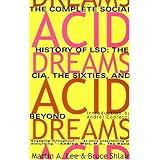
Acid Dreams: The Complete Social History of LSD: The CIA, the Sixties, and Beyond Review

Acid Dreams: The Complete Social History of LSD: The CIA, the Sixties, and Beyond
Average Reviews:

(More customer reviews)
This is surprisingly one of the best books I have read. The authors give a colorfully accurate account of the events that occured decades ago, all of which still echo into our current era. It covers the origin of LSD, as a drug the CIA funded research on for use as a tool for mind control applications using civilians and military personnel as test subjects. At the very outset, it was obvious that the CIA was well aware of the potential power of this substance in its ability to wreak havoc on the collective psyche, to shatter current assumptions and threaten cherished ego boundaries. Yet, eventually it became available to the masses who would come to extol it's use religiously and otherwise.....giving rise to the groundswell of counterculture in the 60's. This book, more than any other source I have encountered, explores the underlying causes of the demise of the cultural/political/self re-evolution of that time and gives us pause to reflect on the politics of consciousness - to see who really won The War Of The Mind. Proof again that truth is stranger than fiction. Be informed.........read this book.

Click Here to see more reviews about: Acid Dreams: The Complete Social History of LSD: The CIA, the Sixties, and Beyond

Acid Dreams is the complete social history of LSD and the counterculture it helped to define in the sixties. Martin Lee and Bruce Shlain's exhaustively researched and astonishing account-part of it gleaned from secret government files-tells how the CIA became obsessed with LSD as an espionage weapon during the early l950s and launched a massive covert research program, in which countless unwitting citizens were used as guinea pigs. Though the CIA was intent on keeping the drug to itself, it ultimately couldn't prevent it from spreading into the popular culture; here LSD had a profound impact and helped spawn a political and social upheaval that changed the face of America. From the clandestine operations of the government to the escapades of Timothy Leary, Abbie Hoffman, Ken Kesey and his Merry Pranksters, Allen Ginsberg, and many others, Acid Dreams provides an important and entertaining account that goes to the heart of a turbulent period in our history. "Engaging throughout . . . at once entertaining and disturbing." - Andrew Weil, M.D., The Nation; "Marvelously detailed . . . loaded with startling revelations." - Los Angeles Daily News; "An engrossing account of a period . . . when a tiny psychoactive molecule affected almost every aspect of Western life." - William S. Burroughs; "An important historical synthesis of the spread and effects of a drug that served as a central metaphor for an era." - John Sayles.

Buy NowGet 40% OFF

Click here for more information about Acid Dreams: The Complete Social History of LSD: The CIA, the Sixties, and Beyond

Read More...

Summer of Love: Ths Inside Story of LSD, Rock & Roll, Free Love and High Time in the Wild West Review

Summer of Love: Ths Inside Story of LSD, Rock and Roll, Free Love and High Time in the Wild West
Average Reviews:

(More customer reviews)
This book is an engaging, densely detailed history of San Francisco rock-'n'-roll from 1965 to 1971. It opens with the Charlatans giving birth to San Francisco rock and ends with the death of poor ol' Pigpen.
Selvin writes in great detail about how bands formed, learned (or didn't learn) how to deal with the music business, and broke up. It's a tell-all about who slept with who, the types of drugs each musician used and where and when they OD'ed, and the details of their recording contracts. To hear Selvin tell it, Janis Joplin bedded just about every male rocker in the business-- except for Jerry Lee Lewis: she got into a fistfight with him! Bill Graham's monstrous ego gets full play, until you get sick of reading about his temper tantrums and underhanded dealing.
But the book's title is misleading, for a couple reasons. For one thing, the summer of 1967 is completely absent from the book! The chronology jumps from spring to fall and ignores the summer altogether. Perhaps this was Selvin trying to emphasize his stark assertion in the book's first sentence: "The Summer of Love never really happened." But why he would deliberately omit the central scene of the whole saga is incomprehensible.
The other thing lacking in this book is a sense of the whole Zeitgeist of the Haight-Ashbury hippie scene. The book has a focus on nothing but rock-'n'-roll music. Any mention of any other cultural aspects of hippie life, like folk music, the Human Be-In, the flower children, the communal Diggers, the arts and crafts, the antiwar movement, the Eastern mysticism, the wider scope of everything that went into the Haight scene, gets no mention except insofar as it directly relates to the story of the rock-'n'-roll bands. This is a book specifically about music, not about all the many things that went into making San Francisco the hippie mecca.
Rock-'n'-roll was of course a central feature of the scene, and deserves a book all its own like this one. It just isn't the last word on it, as the title seems to promise. It doesn't give the reader a feel for the complete Haight-Ashbury experience. An accurate title would be "Rock Music in San Francisco, 1965-1971", or more accurately, "Rock Music in the Bay Area, 1965-1971."
But it does give plenty of information about the unique personalities that made all that amazing music, how they developed their sound, the personal and professional pitfalls they encountered. It shows their development from naive groups of young people beginning by playing in cafes and garages and eventually hitting the big time, bringing their local little music scene, where everyone knew everyone else, onto the world stage.

Click Here to see more reviews about: Summer of Love: Ths Inside Story of LSD, Rock & Roll, Free Love and High Time in the Wild West


Buy Now

Click here for more information about Summer of Love: Ths Inside Story of LSD, Rock & Roll, Free Love and High Time in the Wild West

Read More...

The Haight-Ashbury: A History Review

The Haight-Ashbury: A History
Average Reviews:

(More customer reviews)
> "The Bay area Vortex," is what some insiders called the Haight-Ashbury district during the hippy revolution. The area was a whirlpool that attracted psychedelic drugs and druggies, hippies, politicos, and soon-to-be famous bands, among other American oddities.
Bob Dylan, The Grateful Dead, Jefferson Airplane and the Hell's Angels could be found at dance-hall scenes lit by psychedelic light shows. It was a two-year span, from 1964 to 1966, of acid, Timothy Leary and the Vietnam War. Song lyrics held secret and not so secret messages of drugs and protest. "It was the best of times; it was the worst of times," as Dickens would say.
The Haight-Ashbury: A History starts out a little slow, especially if you are not familiar with that time and place in history. Perry was an insider of the happenings during the, "summer of love," as Bob Weir of the Grateful Dead calls the two-year span, and Perry knows vernacular of the time and place which is much like a foreign language to those of us who are uninformed. He knows the names, businesses, bands, people and the happenings. If all this is news to you, it's a little hard to trudge through this information and make sense of it.
But, if you remember the period, or are curious about the drug culture of the 60s, or if the history of rock bands intrigues you, this is definitely a book for you. There is a 71-page section where Perry writes a journal of the events that happened April through October of 1967. Local police were getting tough on drugs; residents of the Haight were tiring of tour busses full of people invading their space. The darker side of the Haight was emerging. I found this one section to be an interesting essay on society in general.
Toward the book's end, Perry ties the Haight-Ashbury events with what was happening and what had happened around the world and understanding of the "Bay area Vortex," becomes clearer. I went back and reread the opening chapters that seemed confusing at first, but now they made sense. Despite the, " . . .bitterest disappointments and most violent disruption, . . ." noted, Perry ends the book with an uplifting message and uses the history of Haight-Ashbury as an example of a Phoenix that arises from the ashes. An intriguing concept.
Sixteen pages of black and white photographs will bring memories of the events and people to the minds of those who saw this time. For those who are just learning about the era the photographs make the message clearer. You can see a young Jefferson Airplane and Grateful Dead. Timothy Leary shows a faint smile for the photographer and George Harrison is surrounded by admirers on Hippie Hill, August 7, 1967. Samples of the clothes, the art and the hair abound.
Educated at Princeton University and the University of California, Berkeley, Perry followed the psychedelic subculture from 1965 until 1968, when he applied for a job at the Rolling Stone Magazine. Later, he became interested in the history of Middle Eastern food and is now an internationally known authority on this subject.

Click Here to see more reviews about: The Haight-Ashbury: A History

2005 marks the 40th anniversary of San Franciscos Haight-Ashbury district. The psychedelic community was probably the most widely written-about phenomenon of the 1960s apart from the Vietnam War. As unexpected as it was inevitable, the whole eventfrom public manifestation to gaudy collapsehappened in less than two years. In this acclaimed, definitive work, Charles Perry examines the history, the drama, and the energy of counter-cultures defining moment. First published by Rolling Stone Press in 1984 and now re-releasedwith a new introduction by the Grateful Deads Bob Weirto time with Haight-Ashburys 40th anniversary, this highly acclaimed work is a must-have for anyone interested in the original sex, drugs, and rock n roll lifestyle.

Buy Now

Click here for more information about The Haight-Ashbury: A History

Read More...

Love Haight '69: a novel of hippies, activism, and the San Francisco sixties music scene Review

Love Haight '69: a novel of hippies, activism, and the San Francisco sixties music scene
Average Reviews:

(More customer reviews)
Love Haight '69 is thoroughly enjoyable. It's well researched, with a variety of interesting characters. It takes place during one of the most fascinating periods in the history of American pop culture. And it's a great escape back to a time and place when the world was in transition, and people were exploring different lifestyles. It's a great book to get lost in. It's likely to send you back to your stereo time and again to revisit the rich and memorable music from that era as well. I found myself invested in the characters, and while I couldn't wait to see how the stories unfolded, I also hated for it to end. Highly recommended to anyone who misses the late 1960's and is looking for an escape from the world in which we live today.

Click Here to see more reviews about: Love Haight '69: a novel of hippies, activism, and the San Francisco sixties music scene

1969: San Francisco is the epicenter of all things hip . . . at least according to Tula, a young girl arriving fromCanada, obsessed with becoming a flower child, and searching for love in the Haight-Ashbury's fading counterculture. When an ad in a local underground newspaper inspires her to join a community effort to transform a UC Berkeley-owned lot into a "people's park," Tula gets her first taste of activism while falling for a charismatic, politically-savvy grad student. Caught between worlds, she tries to balance the hippies' laidback lifestyle with the protest movement's determination to save the planet. Another little piece of her heart is stolen by the sexy lead singer of a hot new British rock band that passes through town. Throw in a trip to Altamont to see the Rolling Stones, and you've got a year no teenager could easily forget. A rarified post-Summer of Love climate frames the dynamic backdrop for what is a poignant, and often funny, coming-of-age love story. It's Santana, Moby Grape, and the Grateful Dead - Bill Graham's Fillmore West in its heyday. It's Berkeley agitators, Haight-Ashbury freaks, and a Ronald Reagan-regulated mainstream, all struggling to coexist within the close confines of the San Francisco Bay Area. Love Haight '69 is Tanya Coad's first novel. This ode to the sixties paints an experience that is authentic, rich in detail, and delves beyond the usual clichés of what was one of the most exciting chapters in modern day American history.

Buy Now

Click here for more information about Love Haight '69: a novel of hippies, activism, and the San Francisco sixties music scene

Read More...

Ten Years That Shook the City: San Francisco 1968-1978 Review

Ten Years That Shook the City: San Francisco 1968-1978
Average Reviews:

(More customer reviews)
San Francisco is an unforgettable city with a spirit, vibrance, and energy still there. In reading this book which is a collection of essays about life in the city from 1968 to 1978. The decades ends on the twin tragedies of Jonestown followed by the assassination of Mayor George Moscone and his openly gay supervisor Harvey Milk only 9 days later.
The end of the sixties opened the minds, eyes, and ears to a war in Vietnam met with criticism and doubt. The Berkeley campus of the University of California became a symbol of rebellion in a non-violent matter. They held protests against injustice and outrage with passions and convictions. Besides Vietnam, they were still plenty of protests and movements to correct injustice in other avenues.
This book offers a rare insight into the worlds where immigrants were poorly treated as well as Native Americans in the city. The city like San Francisco has a mixture of peoples from all walks of life. I was stunned by the racism that occurred in the predominantly African American section known as Fillmore which was occurring as well. There was a sense of old versus new in the city. It broke my heart reading about thousands of Victorian homes demolished. I don't know if it was for low income housing.
San Francisco reminds me a lot of New York City with the gentrification process. Both cities are expensive for the average person. The West Village in New York City and the Castro in San Francisco were once the center for the gay movements. Today, the West Village is so gentrified and family oriented that something got lost along the way just as the Castro probably has lost that vibrance of protest and cries for justice.
People of all walks of life including women, African Americans, the gay and lesbian communities, immigrants, and other disenfranchised minorities fought back in those years against the injustices, inequality, and degradation. Still, it goes on but now the passion and the flair for change has moved on or moved away from the central location.
The main reason that I bought this book was to read about Jonestown and the Peoples Temple. There was only three pages to the topic. Matthew Roth wrote about his communal experience. The Peoples Temple in the 1970s offered a variety of services including drug and alcohol addiction; counseling; food; shelter; jobs; and a purpose for their members. The tragedy in Jonestown may have been far removed but the remains took more than 6 months to finally be placed at Evergreen Cemetery in Oakland, California. Following the massacre, the remains were at an air force base in Dover, Delaware (three thousand miles away).
I was glad that the author reached out to Laura Johnston Kohl (author of Jonestown Survivor) for her contributions to understanding the tragedy around Jonestown. I was surprised that Congressman Leo Ryan's name was omitted from the text. In fact when the authors were describing the housing politics, they didn't cite the fact that Rev. Jim Jones was on the housing authority board as gratitude from Mayor George Moscone for helping him win the election.
Still, there is so much to talk about with San Francisco and a time that I wished that I had live through where anything was possible. I felt that then Governor Ronald Reagan was far more liberal than we imagined regarding gay rights which isn't surprising since he was from the Hollywood entertainment scene.
I could sit here and write forever till I'm blue in the face about this city and this time period. I still miss San Francisco even though I've only been there once in 1999. The city is hospitable, friendly, liberal, and welcoming at times. The city has it's share of problems such as homelessness, drugs, alcohol addiction, high cost of living, etc. but it's still one of the best cities in the world.
I wished the editor had included a map or maps of the area. There is plenty of visuals such as cartoons and posters and murals highlighting the city's art importance. The book has a variety of interests besides women's rights, gay rights, cartoonists, musicians, murals, Vietnam war, and others to attract the interest of the readers. There is a section even devoted to ecology and organic food long before it became fashionable.
Still, San Francisco has always been on the edge in leading the future. If only more of us would return to stand up for the injustices all around us. That was the meaning of San Francisco during this era, it was to stand up and fight until we all lived equally and just in our society. All I can say is that I love and miss San Francisco and can't wait to go back there for a visit or more.

Click Here to see more reviews about: Ten Years That Shook the City: San Francisco 1968-1978


A collection of essays spans the tumultuous decade from 1968, the year of the San Francisco State University strike, to 1978 and the twin traumas of the Jonestown massacre and the assassinations of mayor George Moscone and supervisor Harvey Milk. This volume provides a broad look at the diverse ways these ten years shook the city of San Francisco and shaped the world we live in today. From community gardening to environmental justice, gay rights and other identity-based social movements, anti-gentrification efforts, neighborhood arts programs, and more, many of the initiatives whose origins are described here have taken root and spread far beyond San Francisco.


Buy NowGet 27% OFF

Click here for more information about Ten Years That Shook the City: San Francisco 1968-1978
Read More...